Explore seven stories from Maine educators who participated in Building Strong Foundations: An Early Numeracy Initiative and brought early numeracy to life through classroom games, family engagement, outdoor learning, and everyday math experiences.
Numeracy at Home
Paige Seymour, Brewer Community School Second Grade Teacher
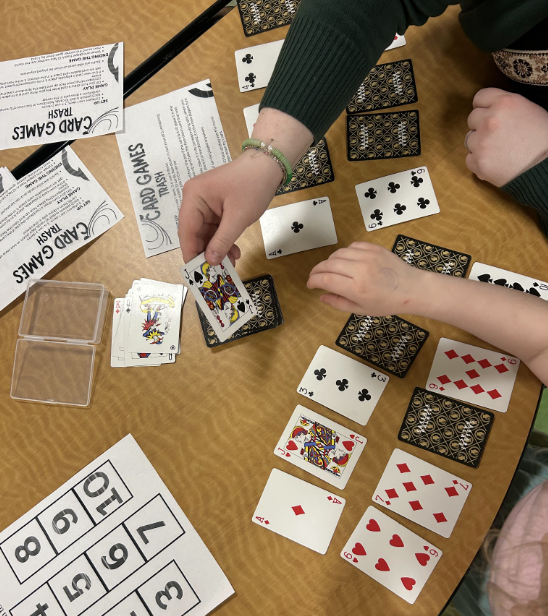
Families are a child’s very first teachers and have many opportunities to help build foundational numeracy skills. As children enter schools, families continue to play a crucial role in reinforcing classroom leading by supporting and extending thinking at home.
As part of the Early Numeracy Initiative, I had the opportunity to plan and host a family math night for Pre-K through second-grade students. Oftentimes, Oftentimes, families want to support learning at home, but it can be difficult to know where to start. Our event welcomed families, gave them hands-on practice with games and activities, and provided resources they could take home to continue supporting mathematical thinking.
During the event, we had ten stations for students and families to explore. Many of the activities could be done at home around the table with dice or cards, in the car through conversations that encourage mathematical thinking, or outdoors using items from nature as manipulatives.
The amazing part was watching families interact together. There wasn’t pressure around math, just the enjoyment of playing games and trying activities together. The comments I heard from parents were incredible, including, “Now I know what my child needs to work on in math and what they are really good at already” and “I didn’t know card games could help my child build their numeracy skills.”
Overall, students and parents were able to have fun together while discovering new ways to incorporate math into their everyday lives.
Kids are naturally eager to learn, and our goal was to give families simple ways to encourage that learning through games and questions that help their children think more deeply and make connections. Simple phrases can encourage deeper thinking:
“Tell me more.”
“How do you know?”
“What are you still wondering?”
These questions can help children take their understanding one step further, make sense of their thinking, and build deeper understanding.
Strong numeracy skills from a young age help students develop confidence with numbers and give them a solid foundation as they begin learning more complex math skills
Math Beyond the Classroom Walls
Julie Montalbano, Biddeford Schools Instructional Coach
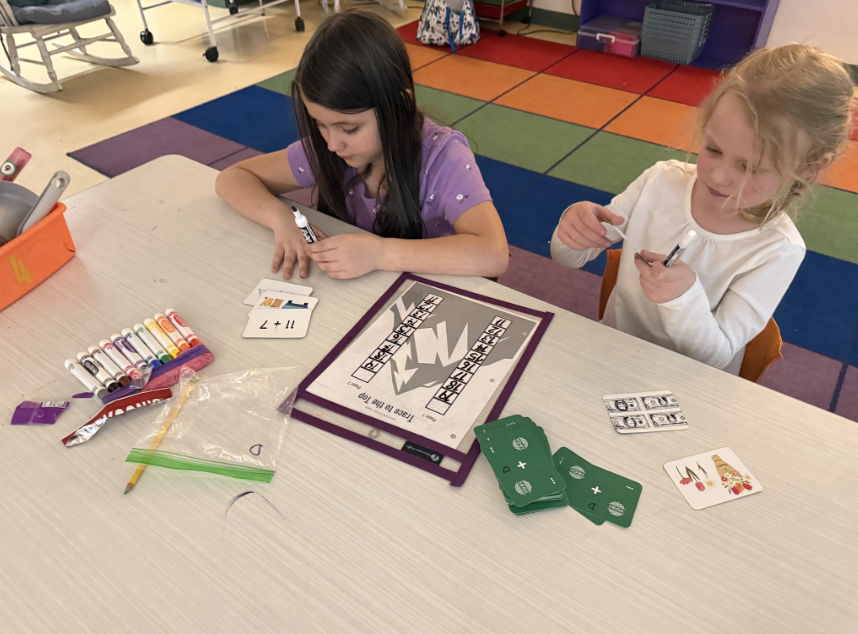
This spring, our first grade team created math take-home kits to help families continue learning at home. The kits included hands-on activities that reinforced important first grade math skills such as counting, sorting, patterning, measuring, geometry, and problem-solving. Before the kits were sent home during spring parent-teacher conferences, students learned and practiced each activity in the classroom so they felt confident trying them at home with their families.
The activities encouraged students to use simple, everyday materials found around the home or outdoors as math tools. Whether counting small objects, creating patterns, building shapes, or comparing collections, students could see that math can be practiced in fun and meaningful ways beyond the classroom.
Families were excited to receive the kits and appreciated having ready-to-use activities to continue learning at home. The hands-on format made it easy for parents to participate alongside their children while reinforcing classroom concepts, and many shared that the activities encouraged quality family time and helped build their children’s confidence in math.
This project was a wonderful reminder that meaningful mathematics can happen anywhere. By providing students with familiar activities and simple materials, we helped extend learning beyond the school day and build connections between math at home and math in the classroom.
Just Playing Around! Or was it…?
Ally Loukas, Fruit Street School PreK Teacher
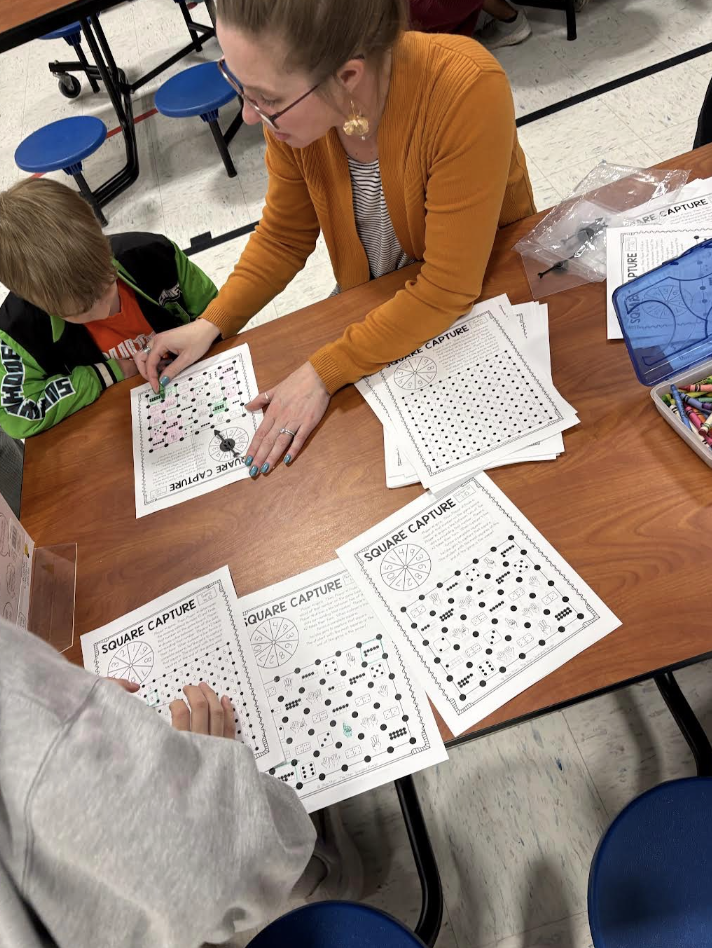
Back in the 90s we always had a family game night. We played Yahtzee, Sorry!, Monopoly, Uno. You know, all the classics! It was something that we looked forward to as a family each week. At the time, it was just my family having fun and spending quality time together. But was that really all it was?
After becoming a teacher, I learned just how important board games are for kids, especially as I found less and less kids were playing. Board games can help kids learn basic operations, number recognition, counting, subitizing, and 1:1 correlation. All of which are essential for students to be successful in math. But even with this knowledge out there, many parents still are not playing games with their kids. Between sports, late nights working, etc. it’s something that seems to be falling to the wayside. So how do we bring that spark back?
After talking about this at school and our Numeracy PD, another teacher and I decided it was a great opportunity to hold an event for families that just focuses on games. We got together and started planning. We worked with our literacy coach who was planning community events to collaborate with us.
We wanted to make sure families had a reason to come to school so we paired our game night with the school book fair. It was a perfect time for parents to come after school and just stop in to play a game. What we found was that pairing it with the book fair made it easy for students to come play games while their parents were checking out books and waiting in line. But our goal wasn’t to just have kids play games, we wanted their parents playing with them. Many parents were stand-offish and didn’t seem to engage until they started seeing more teachers come and play. Once a few parents joined, all the other parents would join their child to play a game. That’s when the real fun started. Families began pairing up and playing Uno or Sorry. We had families laughing and really enjoying themselves. I was shocked that for our one hour event, we had parents stay the entire time playing different games. It was a success for sure.
Each family that participated was given a bag of popcorn to have for their own family game night. We also had hand-outs that gave parents some educational info on why playing games like these is so important. It was a great reminder that practicing math skills does not need to be flash cards but can be real games! With this, because we were able to pair with another school event, we were able to get some funds for “prizes”. Each child that attended will be receiving a bag with dominoes, cards, dice, and a list of fun family games they can play with just those things.
Our feedback from families was strong and positive. Many families reported that they really enjoyed playing games and would love for this event to happen again. Some families even reported that they forgot how fun games can be. We had at least twenty families join in on the fun!
Kids might not remember all the math they learned from those games they played, but they will always have that knowledge and remember the time they spent with their family playing.
Math on the Wall!
Leah Welch, Fruit Street School Teacher
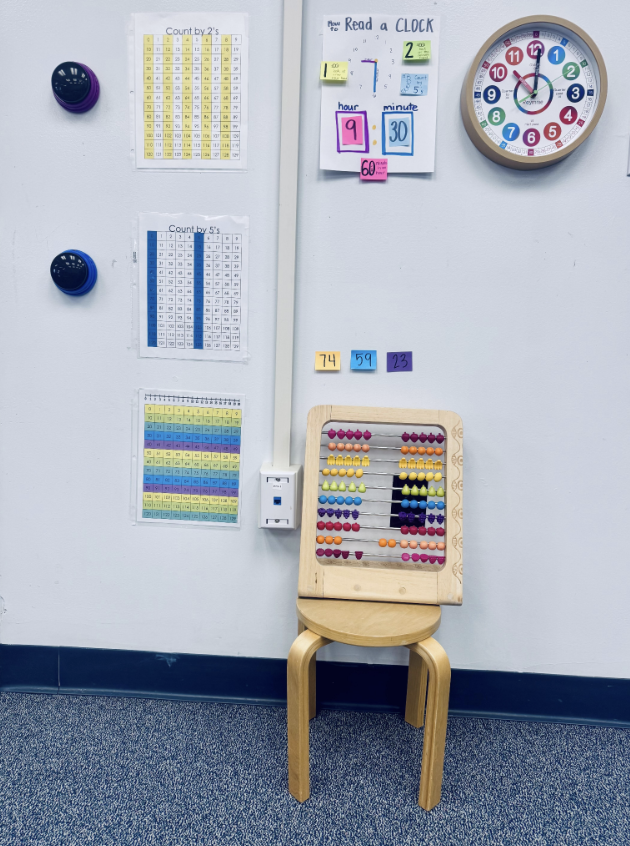
Bringing math to life has been a powerful way to spark interest and nurture a positive math mindset in my classroom. As a kindergarten teacher, I’ve seen firsthand how interactive experiences make learning both fun and meaningful. For young learners, a thoughtfully designed math space can ignite curiosity and foster positive learning habits.
To support this, I created an interactive math wall for my classroom. My goal was to design a space where young learners can engage with math in an encouraging and hands-on way. This math wall builds on the counting skills we are actively working on together. Students can press a button to hear the counting pattern and follow along using the accompanying visual chart.
A colorful abacus invites students to build and explore numbers by moving the beads, allowing for differentiation across a range of numeracy levels. The clock area helps students practice telling time, with clear labels for the hour hand, minute hand, and individual minutes.
Students frequently visit this area, and I’ve found that it naturally sparks thoughtful questions, meaningful math conversations, and exciting discoveries.
Creating spaces like this reminds me that math learning doesn’t have to be confined to worksheets or whole-group lessons: when students are given opportunities to explore, touch, and interact, they begin to see math as something engaging and accessible. My hope is that experiences like these help build confidence, curiosity, and a lifelong positive relationship with math.
Math is Fun!
Kathy Sobel, Cave Hill School Teacher
In our small rural school, it is not unusual to bring students together across grade spans. For this event, we invited Pre-K through second-grade students and their families to experience how math is everywhere and can be fun!
We began our time together with an Estimation to 1,000 activity using Unifix cubes. Multi-age teams of students, parents, and friends stood where they thought the length of 1,000 cube would be, and students started creating their line. The enthusiasm was high, and some students naturally stepped in to help keep the line straight. Teams were given an opportunity to change their predictions, and seeing just how far 1,000 cubes stretched was a great “aha!” moment.
Students were teamed up in groups of ten or fewer for Count Around. The first- and second-graders used place value blocks. Students enjoyed following the count around the circle and anticipating their turns as they changed the value by adding either a unit cube or ten rod. The more familiar the group became with the activity, the quicker they moved around the circle!
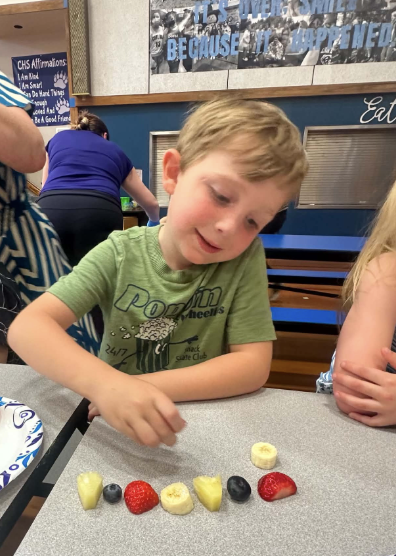
Snack time is always welcome, so why not turn it into a math activity? We provided plates of fruit, and students were given a Sorting and Patterns Challenge to create a pattern and explain it to an adult, all before they got the go-ahead to eat their creations. As students finished their snack, they had the opportunity to compare two numbers after tossing two bean bags, or practice jumping to the next ten with one toss.
Adults at the event were given task cards to show how they could use these same math ideas outside of school.
Counting Around the Classroom
Reba Walton, Dayton Consolidated School Teacher
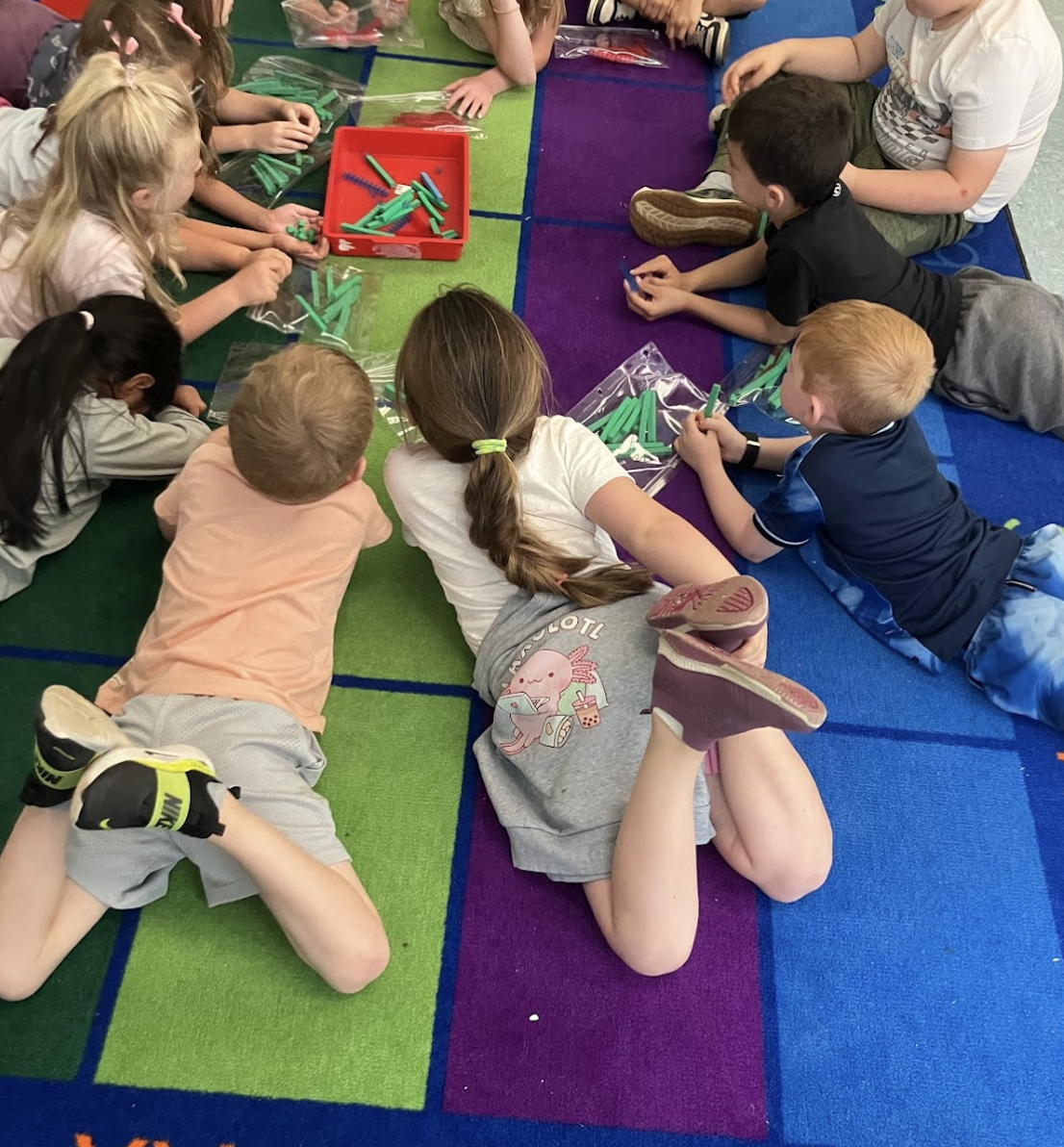
This past spring, I was able to attend the Building Strong Foundations early numeracy training offered by MMSA. In our sessions, we practiced different activities that we could then teach our students. One of my favorites was a count-around activity using math manipulatives, which I love because it can be done as a whole class or in small groups. It also uses supplies we already have in our classroom!
Each student sits in a circle on the class rug with a bag of ten-sticks and one-cubes. Then, one at a time, students decide to add either one or ten to the collection in the center of the rug. As they place their cube or stick in the center, they say the running total of how many are now in the collection. For example, if the first student adds a ten-stick, they say “ten.” If the next student adds a one-cube, they say “eleven.” The game can end once the class reaches a predetermined number. Then, as a class, we check whether the number we reached matches the amount in the pile.
This has become a favorite routine in our classroom, and we often use it as a start or end activity during our math block. My students love working together to see how high the total can go.
Recently, I had a student say, “I don’t want to stop when we get to 300. Can we get to 1,000?” They also love figuring out how to be the one who says the “cool” numbers, like 67!
It has been nice to have another math activity to add to my routines that helps kids build their understanding of numbers. The count-around activity makes math tangible and helps numbers make sense.
Math Munch!
Kate Dawson, Teacher, and Sarah Greenberg, First Grade Teacher, Pownal Elementary School
On a lovely May morning, our K-1 students welcomed their families into the school gym for a special event we called the Math Munch! Families shared breakfast together before diving into hands-on math games and activities designed to show that math can be playful, meaningful, and connected to everyday life.
Throughout our hour together, students rotated through games that practiced counting, number sense, patterns, place value, and problem-solving. There was so much excitement as children showed their grown-ups what they had been learning and proudly explained the strategies they use every day during math class. One of the best parts of the morning was hearing students say things like, “I know another way!” or “Watch how I did it!”
At the end of the Math Munch, teachers had a quick debrief session with adults to talk about our “why” and emphasize that getting the “right” answer is only one small piece of math. Families were sent home with a binder ring full of the games we played, as well as summer extension ideas that could easily be tried at home or outdoors. These kinds of experiences help children see that math truly exists everywhere around them. One parent emailed us: “I loved the idea of using nature items outside and a mini chalk board for math. My greenhouse might need to become a little mini nature math classroom this summer!”
Our goal for Math Munch was not only to celebrate end-of-year student learning, but also to show parents that this is not “new math.” The students are just putting names to strategies that people have been using for years. All of us reason our way through math in everyday life, often without even realizing it! Sometimes parents tell us they feel nervous about helping their children with math because the strategies look unfamiliar. But the truth is, families already use mathematical thinking all the time. Whether estimating a grocery bill, doubling a recipe, comparing prices at a store, or deciding if a calculator answer makes sense, adults are constantly using number sense and reasoning skills.
That reasoning is exactly what we want students to develop. While calculators and technology can help us with quick operations, children still need a solid understanding of numbers in order to recognize whether an answer is reasonable. The strategies students learn today are designed to help them think flexibly, explain their reasoning, understand how numbers work rather than simply memorizing algorithms.
We also hope families can see that math does not need to happen only through worksheets or notebooks. Children build mathematical thinking when they explore, notice patterns, estimate, compare, and solve real-world problems in joyful ways! There are so many ways to bring math into everyday routines: counting shells at the beach, measuring ingredients while cooking, creating patterns with rocks and leaves, estimating how many steps it takes to reach a destination, or comparing the sizes of plants and trees on a nature walk.
It was wonderful to see families laughing, learning, and exploring numeracy together through conversation and connection! We are so grateful to all of the families who joined us and helped make the morning such a success.
Read More Stories!
For more great stories and inspiration related to Outdoor Math activities in action, visit the Numeracy in Nature(opens in a new tab) resource site.
Building Strong Foundations was funded by the Maine Department of Education as a component of their Maine State Numeracy Action Plan(opens in a new tab). Title IIA funds received from the U.S. Department of Education (ED) support the implementation of this project. The project has an award totaling $119,422.62 of which 100% is federally funded and directly attributed to project implementation. The contents are those of the author(s) and do not necessarily represent the official views of, nor an endorsement by, ED or the U.S. government.