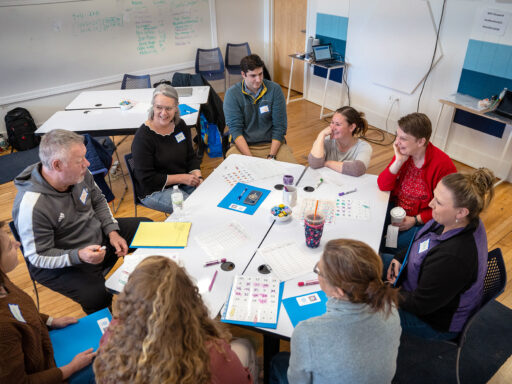
Below are the workshop sessions we plan to offer at the 2026 STEM PD Retreat. Sessions run for either 1 hour or 45 minutes and will be facilitated by MMSA staff, with some co-facilitated by teacher leaders.
The session schedule and additional details will be provided in February, at which time participants will choose the four sessions they would like to attend.
Sessions
Asking Purposeful Questions
Asking great questions is one of the most powerful tools an educator can use—but purposeful questions don’t happen by accident. In this session, we’ll examine the structure and process of questioning and discuss how to listen more effectively and follow up with youth throughout STEM learning experiences. You will learn how purposeful questioning creates space for reflection, supports deeper reasoning, and builds stronger connections with learners across settings.
Subject: Informal
Grade: K-12
Bringing Real-World Science to the Classroom
How can we make science learning feel as authentic, dynamic, and relevant as the work scientists do every day?
This workshop explores practical strategies for bringing real-world science and data into the classroom to deepen student engagement and understanding. We will examine ways to use current phenomena to anchor units and storylines that reflect how scientists investigate questions and solve problems. We’ll discover how to integrate authentic data sets and analysis practices that build students’ data literacy and scientific reasoning, as well as approaches for incorporating STEM careers to help students see themselves as future scientists and problem-solvers.
Subject: Science
Grade: 6-12
Connecting Youth to Challenge-Based Learning
Join us for tips and tricks to help make STEM career connections throughout the school year. You’ll experience several easy-to-implement strategies, including a photo elicitation activity, learn about how youth form STEM identities, and then learn how to conduct related activities with youth. This session was adapted from the ACRES work with afterschool educators and will feature resources from STEM Next’s career-connected learning framework and Apple’s Challenge-Based Learning Framework.
Subject: Informal / General Professional Development
Grade: K-12
CS Summer of Fun Taster
Interested in learning more about computer science (CS) or thinking about attending CS Summer of Fun?
Join us to experience the kinds of activities offered at CS Summer of Fun, a weeklong dive into computer science activities and integration for everyone from newbies to longtime CS champions. This summer’s event will be held the week of July 20 at Colby College and Maine educators come for FREE with room and board, plus and stipend.
Subject: Computer Science Integration
Grade: K-12
Discover OpenSciEd: Free, High-Quality Science Curriculum
Looking for a science curriculum that truly engages students in figuring out the world around them? We endorse OpenSciEd because it’s high-quality, rigorously field-tested, and freely accessible, offering a powerful model for meaningful, phenomenon-driven science learning.
In this interactive session, we will experience what makes OpenSciEd a strong fit for today’s classrooms by exploring how each unit is built around an anchoring phenomenon that sparks curiosity and drives student investigation. Learn how driving question boards support student-centered inquiry and how navigation routines help students reflect and plan next steps. You’ll leave with a practical overview of the curriculum’s structure, instructional routines, and open resources, and be ready to access the full library of free high-quality materials to bring authentic sensemaking to your classroom.
Subject: Science
Grade: K-12
Empower Your Students to Navigate the Future of AI
Teach core concepts, not just tech. In this session, we’ll explore how to make AI accessible and allow students to explore AI’s inner workings (input, process, output), and understand bias. To keep up with our current times of rapidly changing technology, we’ll focus on how to empower critical thinking and digital citizenship.
Subject: Computer Science
Grade: 6-12
Experience Building Thinking Classrooms K-12
Experience real math thinking with other educators through the Building Thinking Classroom (BTC) practices. Explore different ways to close a thinking task and learn how to synthesize student thinking through shared discussion and quadrant notes. The session will focus on new understandings in meaningful notes and consolidation practices.
Subject: Math
Grade: K-12
Exploring Local Environments Through Nature Journaling
Engage your students in science through the power of place! We’ll experience how nature journaling can be both a reflective and scientific practice, helping learners of all ages connect with their local environments.
Through guided drawing, writing, and observation, you’ll learn ways to foster curiosity, data collection, and creative expression in your classroom. We’ll cover strategies for outdoor and indoor settings, adaptations for different grade levels, interdisciplinary connections, and explore resources to bring place-based inquiry into your teaching and personal practice.
Subject: Science
Grade: K-12
Fluency Games with Integers
Engage in fun, visually rich games that will build your students’ math understanding around integers. Great for middle school grade-level work as well as high school intervention. Walk away with games to play!
Subject: Math
Grade: 6-12
Game Theory and Coding with AI
In this session, we’ll introduce the classic game theory scenario, “The Prisoner’s Dilemma.” In groups, you’ll use AI assisted coding to create a strategy to recreate Robert Axelrod’s famous “Axelrod Tournament,” and compete in iterated prisoner’s dilemma rounds to see what strategy comes out on top. You’ll learn about game theory, get hands-on experience with AI assisted coding, and collaborate with other educators as each group tries to take home the win.
Subject: Computer Science
Grade: 6-12
How to Host Community STEM Nights
Community STEM nights have become a fun and impactful way to provide engagement opportunities for community members and highlight Computer Science-driven careers. In this session, learn valuable insights from a panel of educators who have hosted STEM nights in their communities, and find out how to create a successful event of your own.
Subject: Networking
Grade: K-12
Let’s Talk Differentiation and Intervention
Together, we’ll examine how research on effective math differentiation and intervention has evolved over the past decade and explore how these changes shape our planning.
Subject: Math
Grade: K-12
Machine Learning with Micro:bits
Discover how to use micro:bit’s CreateAI platform to train an AI model on movement sensor data. In this hands-on session, you’ll train a model using your own movements and use MakeCode to trigger sounds or images when the micro:bit recognizes your actions. We’ll introduce the CreateAI tools, share ideas for integrating them into ELA and science, and provide micro:bits for use during the workshop. Just bring a laptop device (tablets are not compatible) with a USB-A connection or dongle.
Subject: Computer Science
Grade: 9-12
Math Fluency Games for K-5
Engage in fun, easy-to-implement games that will build your students’ math fluency. Walk away with games to play tomorrow.
Subject: Math
Grade: K-5
Reflecting on the Evidence of Burnout
Do you know how to use the evidence-based strategies to help you or your educators recognize the signs of burnout and implement sustainable self-care strategies?
Rooted in research, this session encourages reflection, boundary-setting, and the development of realistic, personalized self-care plans. We will explore the connection between wellness and teaching quality and receive resources that can be implemented in classrooms generally and schools more broadly, fostering a culture of wellness across your educational setting. This will be led by an MMSA partner who runs 21st CCLC sites in Skowhegan, Maine.
Subject: Informal / General Professional Development
Grade: K-12
Science and Math Outdoors
Are you wanting to spend more time outside, but need help aligning standards with activities?
During this session focused on exploring environmental phenomena to engage in sense-making, you’ll learn about open-source K-6 lesson plans to engage students in meaningful science and math lessons outdoors.
Subject: Math, Science, Outdoor Learning
Grade: K-6
Setting the Stage for Play-Based Science and Engineering in Early Childhood
Discover the brilliant and intuitive ways young children engage in science and engineering through self-directed play. Learn how to spark their curiosity and enrich their investigations through purposeful play environments, open-ended materials, and well-timed teacher moves.
Through video examples, we’ll explore how young learners ask questions, analyze data, and design solutions through play. Walk away with field-tested SciEPlay tools and practical strategies to implement in your classroom and outdoor spaces.
Subject: Science
Grade: PreK-2
Teach ME Outside: Building a Culture of Teaching Outside
Learn to engage other educators and create a culture of outdoor learning at your school. We’ll explore strategies to support taking students outside, foster a conversation among your colleagues, admin, and community to support long-term change, and navigate available open-source resources.
Subject: Outdoor Learning
Grade: K-12
Using Data Science to Navigate Rural Energy Transitions
How can students use data science and modeling to amplify their voices and engage with their communities on energy transitions?
Explore how to support middle school students in using data analysis to understand the economic, environmental, and social impacts of energy transitions in rural communities. Leave with strategies for integrating local data and stakeholder perspectives into your classrooms.
Subject: Math & Science
Grade: 6-12