Building a Dataset of Diverse Mathematical Reasoning from Additive to Multiplicative Reasoning
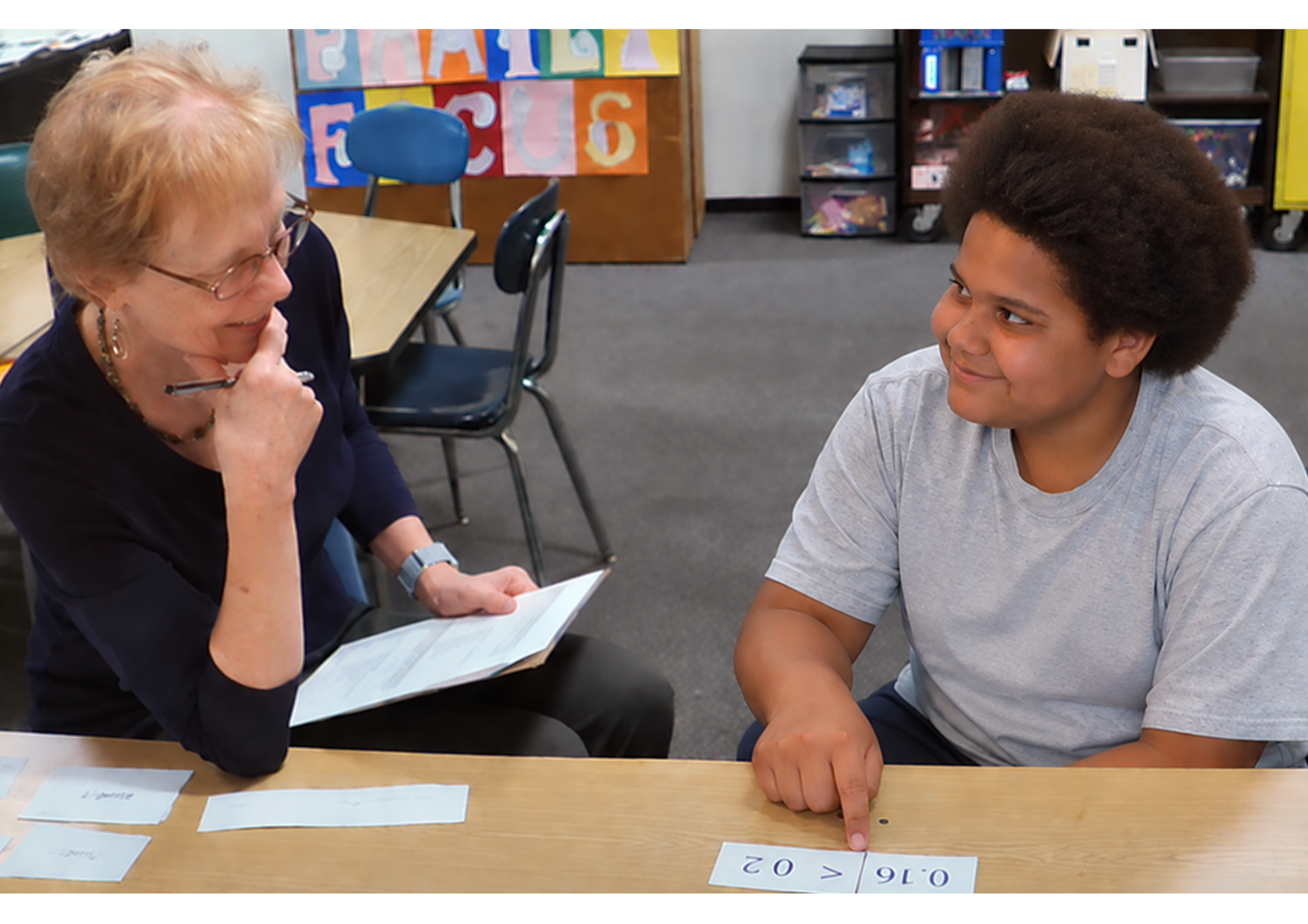
The Learning from Student Thinking pilot project partners with elementary educators to study 3rd through 5th grade neurodivergent students’ mathematics reasoning and how they communicate what they know in different ways.
Through this project, the Maine Mathematics & Science Alliance (MMSA) and TERC(opens in a new tab) are partnering with approximately 40 teachers nationwide to build a first-of-its-kind public dataset of elementary students’ mathematical reasoning, funded by Digital Promise.(opens in a new tab) The project will focus on neurodivergent learners and the important transition from additive to multiplicative reasoning, helping researchers better understand how students develop mathematical ideas and how to better support student learning.
Join the Project!
We’re seeking educators who want to deepen their understanding of how neurodivergent students in grades 3–5 transition from additive to multiplicative reasoning, a critical foundation for proportional reasoning and algebra.
- Receive training in the mFITT formative fluency interview to help you identify students’ strategies and representations and make responsive, equity-minded instructional decisions, including for neurodivergent learners who may communicate their thinking in varied ways.
- Interview five neurodivergent learners using a formative interview with around 12 short fluency items per student. For this project, neurodivergent learners include students who have neurological differences, such as dyslexia, ADHD, autism, learning disabilities, or dyscalculia, among others, as documented in an IEP or 504 Plan or through student self-identification.
- Collect and successfully submit the required interview information, which may include recordings or transcripts, student work, teacher observations of student reasoning and representations.
- Contribute to a proof-of-concept project exploring how AI might help teachers recognize patterns in student reasoning while maintaining strong standards for privacy, de-identification, and responsible data use.
Logistics & Benefits
- Receive a $700 stipend for your participation: $200 for completing the training and $500 for completing and successfully submitting five student interviews.
- Earn six contact hours for completing the formative fluency interview training.
- Participation runs from November 2026 through June 2027. Initial professional learning will occur in late fall 2026, with student interviews in early 2027.
Apply by October 31!
Educator Consultants
We’re also seeking Educator Consultants to join a team of six educators with experience supporting grades 3-5 neurodivergent learners in mathematics. These consultants will facilitate participant trainings and support the interview and data collection processes. This is a 10-month consulting commitment of approximately 150 hours with $5,000 in compensation. Learn more and apply by October 15.(opens in a new tab)
MMSA Project Staff

STEM Education Specialist

Research Team Lead

STEM Education Specialist

Research Associate

Research Assistant
Project Partners

Audience
Subject
Project Funding

This initiative was made possible through the generous financial support of Digital Promise through the K-12 AI Infrastructure Program.
Any opinions, findings, and conclusions or recommendations expressed in this material are those of the author(s) and do not necessarily reflect the views of the funders listed above.