Transdisciplinary Learning: A Holistic Approach to STEM Education
Posted on
The real world isn’t divided neatly into subject areas, so why should learning be? That is why transdisciplinary learning is so powerful. This approach invites educators and students to embrace the messy, interconnected nature of real life, where ideas overlap, problems are multifaceted, and solutions demand more than one way of thinking.
Teaching within a transdisciplinary context engages educators and students in open-ended, project-based learning while encouraging them to delve into multiple subjects simultaneously. Unlike multidisciplinary learning, where disciplines are taught separately around a common theme, or interdisciplinary learning, which involves teaching different disciplines around a specific theme, transdisciplinary learning is distinguished by learning that connects to real-world problem solving, is project based, and brings together multiple disciplines in a context that is co-created by students (Vasquez et al., 2017).
One current MMSA initiative that has transdisciplinarity at its core is the Smart Greenhouses project. Using curriculum developed by the the Boston College Lynch School of Education and Human Development(opens in a new tab), MMSA facilitators equip participating teachers with the tools and knowledge to invite students to drive the learning process, combining computer programming, data science, and plant science. Students can control the greenhouse environment by programming a microcomputer to control sensors, fans, and lights using block coding software. The smart greenhouses provide open-ended environments for experiments, analyses, and multifaceted skillbuilding.
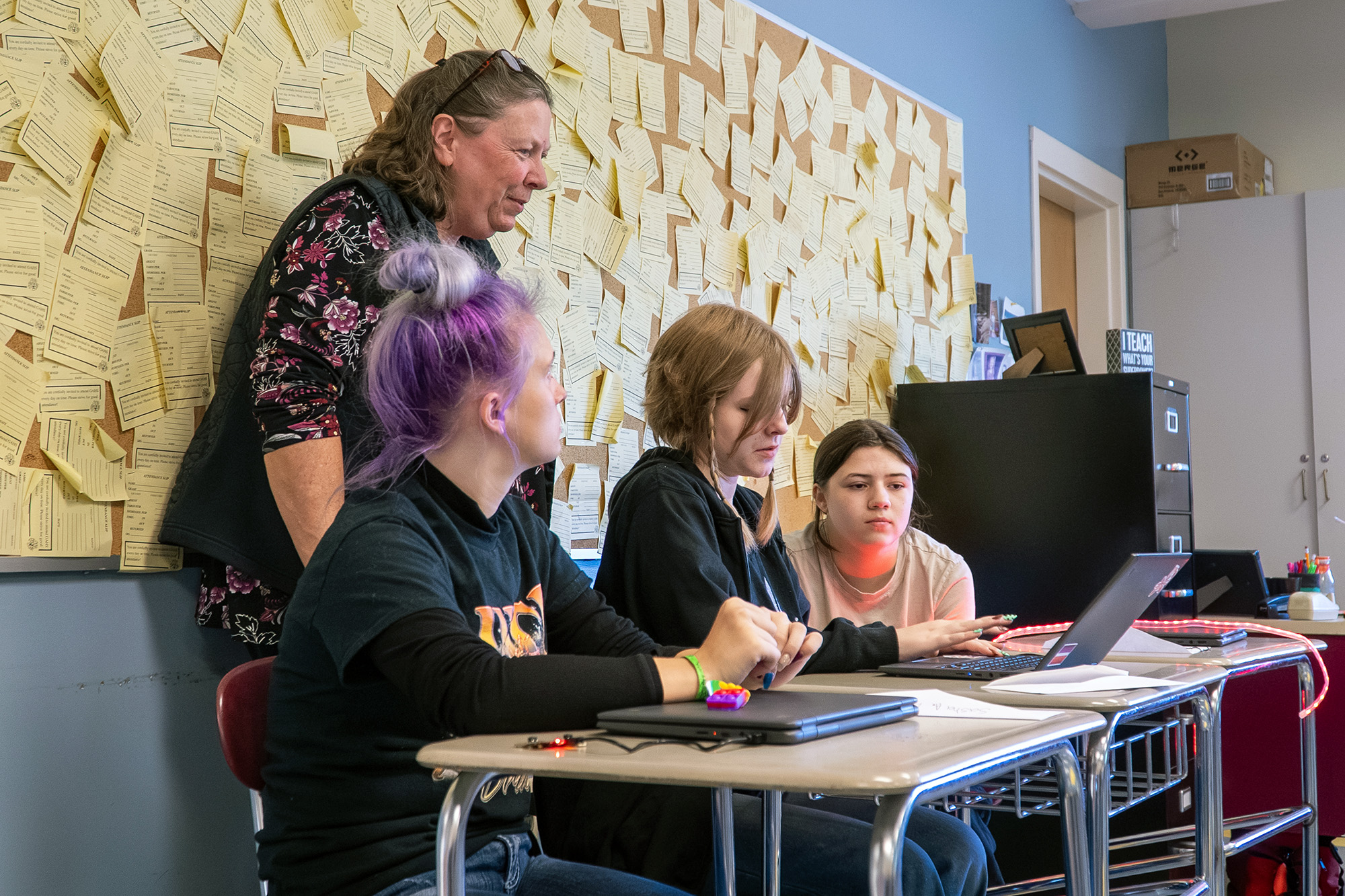
Carolyn Arline, a Gardiner Area High School teacher, has 29 years of teaching experience, 10 of which have been as a computer science teacher. She described the experience of her students working on this project as “opening up the learning for them to be free to learn, and to enjoy, and to explore more than anything I’ve done.”
On a recent site visit, her computer science class was busy checking the progress on the greenhouses they had placed in different parts of the school building. “They decided as a class: one group was going to put a greenhouse down at the end of the building, in a room where the sun comes up. Another would put one on the other side of the building where the sun goes down. And then one was in the classroom, which is in the middle. They collected data, and today we went and got all of the greenhouses and they had to see what their data showed, analyze it, and report on what they thought all that analysis meant.”
Letting students have more freedom to direct the learning experience changes the classroom dynamic, often in surprising and refreshing ways.
“These students want to explore so much, I have to let myself say: it’s time to explore and not rush through it. I’m not the teacher, I’m in here with them, guiding them, giving them some ideas on what to do; they’re teaching me as much as I’m teaching them. They’re helping each other and encouraging each other to go further.”
What the Smart Greenhouse project shows is that transdisciplinary learning can elevate concepts beyond the sum of their parts. Learn more about this project and other MMSA’s projects currently recruiting teachers to join them in bringing transdisciplinary learning to classrooms across Maine.
To learn more and apply to join the 2026 cohort of smart greenhouses educators, visit the project page.
Vasquez, J. A., Comer, M., Villegas, J. (2017). STEM Lesson Guideposts. Heinemann.